
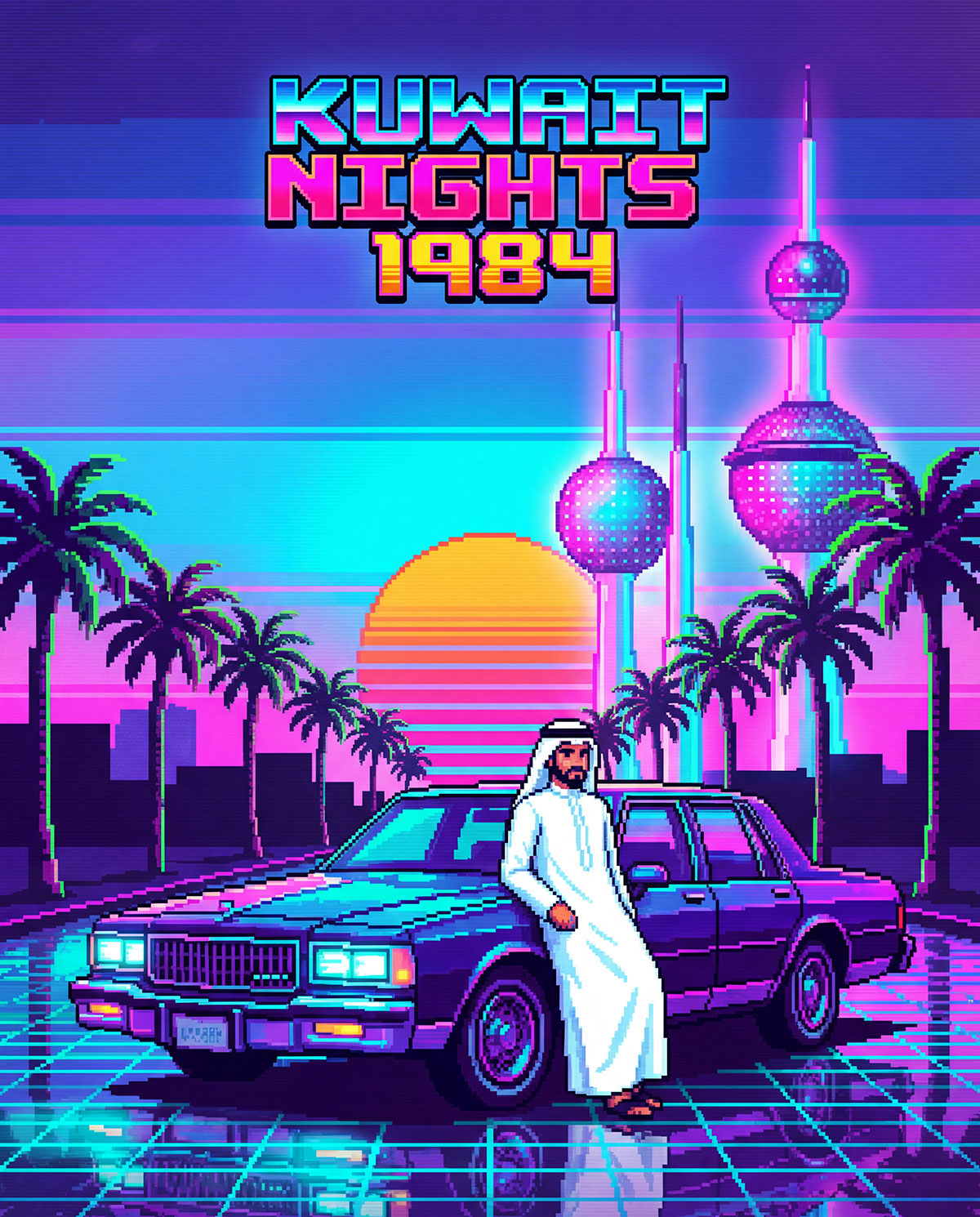
Yesterday I shared a video called Kuwait Nights 1984 created by Faisal Alrajhi and instantly fell in love with it. He created the video using AI, so after sharing his post on my story I got in touch with him to see if he could share his process with my readers.
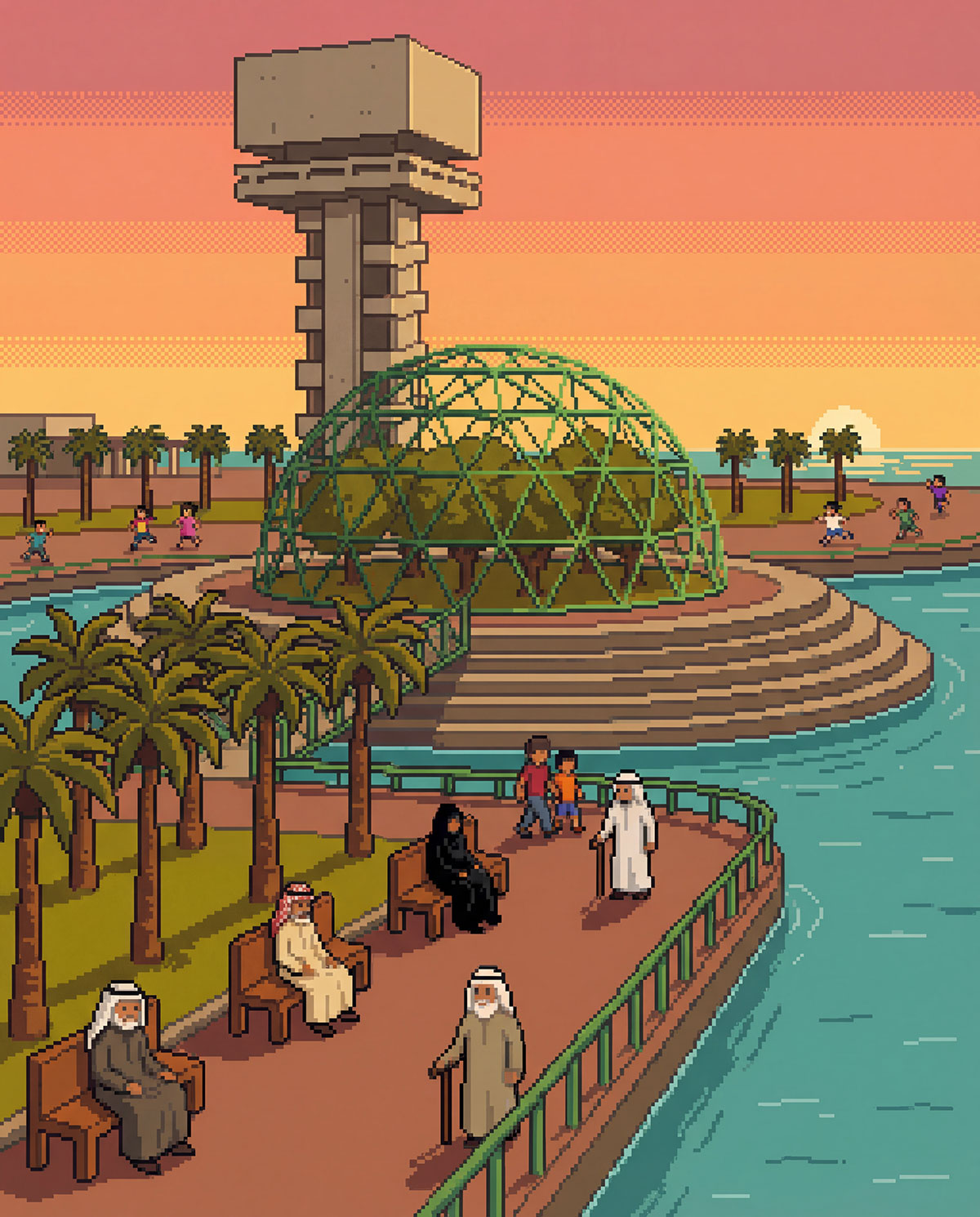
Due to the length of his project he couldn’t share the full breakdown, so instead we decided to focus on one of my favorite scenes, the Green Island sequence.
Step 1 – Creating the visuals
The first thing Faisal did was create a custom prompt on Google Gemini:
“Create an 8-bit pixel-art scene of Kuwaiti people relaxing, sitting on benches, and walking inside Green Island. Show the iconic tower in the background, kids running in the distance, and palm trees lining the walkways. Use retro warm tones and subtle pixel shading.”
For the pixel-art images, he used the Google Gemini app along with Freepik’s Nano Banana feature. Freepik gave him higher-resolution results, which made a big difference when putting everything together into a video. He also added reference photos he found on Google, like shots of Green Island, to help the AI recreate the scenes more accurately.
Once he had all the images generated, he did some light touch-ups in Photoshop to clean things up, fix small details, and remove anything the AI added that didn’t belong.
Step 2 – Converting stills to animation
Once he had a scene he liked, Faisal then animated the images using an image-to-video AI tool from Freepik.
Step 3 – Creating the soundtrack
For the music Faisal used the AI music generator Suno. He gave Suno 30 seconds of the original song he wanted to use then used the following prompt to convert it into an 8-bit video-game style soundtrack:
“A playful 8-bit track opens with bright, pulsating chiptune synths and a bouncy, syncopated square wave melody. Driving 8-bit percussion interlocks with rapid arpeggios, playful sound effects, and simple bass, keeping the energy high. Short bridge introduces quirky glitch textures.”
Step 4 – Combining the scenes
The final step was putting everything together, he used Final Cut Pro.
So in case you want to replicate this video style, just follow steps 1 and 2 over and over for the different scenes and then combine them using a video editor.
When I posted this on Instagram, someone people left comments hating on the fact AI was used to create this. I think there is a huge misconception or naivety on how difficult and even impossible it would be to create a video like this without AI. One follower left a comment saying that Faisal should have instead “learn how to do pixel art and write music” as if it’s something someone can do by watching a YouTube video and not requiring any talent. I think that comment is actually more insulting to artists than him using AI to create this video. But even if Faisal was a pixel artists, it wouldn’t necessarily also mean he would know how to animate or compose music. Even if he did, the process of creating something like this would have taken months. Hiring a team to create a video like this especially when it’s something just for fun is also not realistic or feasible. AI has its issues, but in this instance it’s allowed someone to create something that wouldn’t be possible without the use of AI.
Make sure to check out Faisal’s Instagram account, he posts a lot of cool tech videos and they’re always informative. @f_alrajhii
15 replies on “The Making of the 1984 Kuwait Nights Video”
What’s insulting to artists worldwide is their work being used without their permission to train for-profit AI media generators. And more AI usage means less incentive for future talent to learn how to creatively make content using tools without AI. We’re losing our creative selves over time. AI can’t make anything completely new, it’s just regurgitating whatever it has been trained on. For now, it can generate what it has learned from human-generated content so far, but when humans produce AI generated content, it creates a closed loop and the enshittification begins. These models rely on actual artists making real content, and once they are out of business, there’s nothing new that will come out of AI generators. That’s just my two cents.
We train ourselves over other people’s work, videos, tutorials, books etc. Why aren’t we considered copying? There is a lot of misplaced bad hype around AI because it will be replacing a lot of people’s jobs and that was the exact same issue when computers came to be. What’s the difference between placing a photo in photoshop and having it turn it into pixel art using a filter versus uploading the same image to ChatGPT and asking it to do the same? Nothing but but doing it with AI instead of a plugin it gets a bad rep.
The video is wholesome and I really liked it, but honestly I can’t help but feel uneasy as an artist. I’m not a pixel artist myself but I love pixel art and have been following a lot of genuine pixel creators who create artwork pixel by pixel and manually animate it, the process can be painstaking work and they willingly work months to come out with a pixelated story out of passion. Whilst creating any form of art, it’s about creating something unique to you and the craft, effort and meaning that can take. Then you have A.I bypassing the difficulty, labor and value in all of that to come out with something someone may have been working hard for behind the scenes. It just doesn’t sit right. The amount of times I saw something cool only to be severely disappointed that it was just an A.I render are countless whether in photography, video or art. It’s impressive at first glance…then that wow factor evaporates.
At the end of the day if one can create this using A.I, where does this place actual artists who are now always accused of using A.I. and not their efforts. When people start conflating the two, it’s a problem to be honest.
A.I is very useful and Im not villainizing it entirely, but there are people who do put in the actual work.
The fact that you keep emphasizing “actual work” as if what this person did was nothing is so demeaning. What he did is also art and is just bypassing a form of the labor which is what happens when you innovate things. Why do “pixel artist” use a computers to consolidate images manually? Why don’t they just sketch it themselves? Or even more, why use ready made colors, just mix your own? It’s actually ridiculous how these so called “real artists” keep getting offended because someone figured out a way to bypass their methods and achieve similar or better results all of a sudden they turn into purists.
I do art myself and I do it in the old fashion way, whether it’s playing the guitar, piano, sketching but do not correlate the AI stuff (which is amazing) to what I do because they are different and special in their own ways. It is not a problem, it is fear in people because their efforts are becoming more and more irrelevant even though they are not.
After that entire paragraph I wrote, it should be pretty clear that “actual work” meant making real pixel art with drawing software and know-how. You think highlighting the efforts of artists as opposed to using A.I, is demeaning somehow? Very odd. Digital artists are artists too, I can’t believe you think their work is comparable to A.I. There is a lot that goes into digital art, just take a graphic design class because you really sound clueless. Your entire rant is insulting to the art community – these people take years to hone their skills to perfect their craft. I dont mind the guy experimenting with A.I and generating something fun, but he isn’t an artist. He is a tech guru/reviewer who showcased the power of what A.I is capable of generating. And the fact that you gloat that A.I can cheat artists and do “the job” better than them is an awful perspective to have for the creative human mind.
I understand what you’re saying but technology has been taking over many of our tasks for decades. If you replace the word AI with computers you end up with the exact same argument and discussion people were having back when computers started taking over many jobs.
I used to design websites as a side hustle when I was in university in the 90s. Initially you needed to know HTML so you could code a website, then software like Microsoft Frontpage and Macromedia Dreamweaver started popping up allowing normal people with no HTML experience to start creating websites. Then websites like Square Space started popping up which made it even easier for normal people to create websites with just a few clicks of a button. I obviously had to adapt early on and do something else but a lot of web designers lost their jobs and AI wasn’t involved then.
I agree but these tools you mention didn’t steal content from artists and massive amounts of user data that we are forced to accept being collected from us the moment we start using our laptops phones, and cloud services.
I don’t think it’s ethically right to profit from stolen content while hoarding massive amounts of natural resources like water, electricity and storage, ram, GPUs, most of which is used to generate slop. All our electronic devices are going to drastically go up in price next year because these handful of AI companies decided to choke the supply of chips to retail consumers. And this will cause a butterfly effect making services expensive in other industries because they’re starting to use AI. How do these companies compete? By collecting more data from us. Look at the new microsoft copilot laptops literally recording your screen full time and they’ve made the whole operating system so bloated. Who is asking for this? No one. Investors are shoving AI down everyone’s throats because they want to see a return on the billions they spent and the best we see now is slop. If everyone can be a talented artist by typing in a prompt, then no one is talented. Would you preserve vinyls of songs created by AI?
If I came to you and asked you to create a pixel art image of myself and you went on YouTube, watched a tutorial and the found a few artists work online u liked and using them as inspiration created the pixel art image manually on the computer for me. Is that considered stealing? Because not everything AI does is stealing.
Your comment actually sounds like a bunch of clickbait headlines you read this morning on reddit just turned into sentences. Only headline missing is something about AI being a bubble that’s going to burst.
If someone made a tutorial, it was intended to be followed or copied. And no, taking inspiration isn’t copying. Gen AI isn’t doing that. And if AI doesn’t steal, I guess I can make my own blog, ask chatgpt or gemini questions about Kuwait, copy the answers it gives me with just a little transformation or paraphrasing and paste them on my own page as my own work?
https://i.postimg.cc/V63BYXxh/Chat-GPT.jpg
Whatever I said above sounds clickbaity, but it’s true so it isn’t clickbait.
https://news.mit.edu/2025/explained-generative-ai-environmental-impact-0117
https://www.bleepingcomputer.com/news/microsoft/windows-11s-recall-ai-is-now-rolling-out-on-copilot-plus-pcs/
https://www.reuters.com/business/micron-exit-crucial-consumer-memory-business-2025-12-03/
https://www.tomsguide.com/computing/ram-prices-are-exploding-heres-why-and-everything-you-need-to-know-about-surviving-ramageddon
Ok let’s go with that, if someone made a tutorial and AI learned using that tutorial is that stealing? So why are you assuming just because AI knows how to do something it stole it? What if someone created a software based off a tutorial that creates pixel art is that stealing? I think just because you’re see the term AI and reading headlines about AI learning from content that it’s stealing. It’s not.
If you want to create a blog and have chatgpt write the content you can, a lot of local instagrammers are already doing that, that’s fine by me, I’m not worried.
Micron dumping crucial isn’t the end of the world, it was a 15 sec clickbait headline, stocked dropped 5% that day, it’s now up over 12% since.
I am away for work and not in the right space of mind to write a lot. But we cannot be anti-AI because many things that we use on a daily basis is automated, pre-AI generation that uses some AI specifics that has eventually made someone lose their job or had to settle for a lower pay.
I hate that many people are losing their jobs and many more are going to be jobless in the next few years. To push AI, Jensen and his other AI buddies said that AI isn’t taking jobs away but people who don’t use AI would be losing their jobs. They are going to be right only for a few years. Eventually, most jobs that a machine can overtake will reduce jobs or bring the man power to NIL. Even if a person is required to prompt the AI, his pay will be reduced to a bare minimum since his efforts will be low compared to pre-AI days.
I head the Marketing operations of my company and I am observing much less effort being put by humans to generate artwork in 1/100th of the time or less. We can protest all we want, but eventually we are going to lose most of the battle to AI.
Generative AI is not your friend. There’s the environmental impact where millions of gallons of water has to be used to cool all those server farms. Not to mention that people living near these server farms have their electricity bills shoot up in price.
AI is becoming more and more complicated and problematic as time goes on. Would you be happy if someone made a blog like yours and had an AI do all the work without the effort?
Do you know how many people just in kuwait alone have blogs like mine and AI doing all the work? There are literally two that copy paste, reword and repost. Come on be real. Not only that, just go on some popular instagram accounts and read the captions, even newspapers are using chatgpt.
If you think AI is going anywhere or going to slow down you’re not being real. You’re highlighting the impact on water and power as things anyone cares about. These are two issues that will get solved easily because they are urgently needed. Just yesterday I read an article about how they’re looking for new faster tech to generate the electricity needed including supersonic turbines https://boomsupersonic.com/flyby/ai-needs-more-power-than-the-grid-can-deliver-supersonic-tech-can-fix-that
Neat! Loving this post. The question I have is this: was the Chevrolet Caprice something prompted, or did the AI already know that it was the car that was ubiquitous in Kuwait in 1984? Even my dad drove one, LoL.
Very divided opinion with the whole AI debate, as for the art , it’s wow as for the artists who this is affecting i have 2 thoughts,
1 ) it sucks that a computer generated model can do something in 2 to 10 min what would take a person hours or days.
2) like everything else we must all eventually upgrade or atleast be aware on how to prompt and use ai as whether we like it or not it is the future. I am a firm believer that if something saves you time and energy then that makes you efficent.